Albany, NY · Garage Door Service
Garage Door Advice for Albany's Older Housing Stock
Albany homes built mostly 1938-1982 run original hardware into cold winters. Here's when to wait, when to call, and why these doors fail the way they do.
- Repairs & new doors
- Springs & openers
- Serving 4 nearby communities
Doing Nothing For Now
If your door on a house built in that 1938-1982 window - the median here sits right at 1961 - is making noise but still opening and closing square, you can usually wait. A torsion spring that's a little noisy, a roller that squeaks on the way up, a track with minor surface rust: none of that is an emergency in a cold-climate area like this one. What you're waiting for matters, though. Albany winters put real stress on steel that's been cycling since the Johnson administration. A spring under tension in a cold garage loses a little elasticity with every freeze-thaw, and a door that's merely loud in October can seize in January. So "doing nothing" has a shelf life here that it wouldn't have somewhere with a mild winter. Check the door monthly through the cold months - lift it halfway by hand with the opener disconnected and see if it holds. If it drops or shoots up, stop waiting. One honest limit: if the door is original to a house built before 1970, patching one worn part often just moves the failure to the next worn part. At some point doing nothing stops being free and starts being a slow trade for a bigger repair.
When to Get Help
Call before the door fails completely, not after. On the older housing stock that makes up most of this service area - 1960s and 70s construction across the 41 named areas we work in - the warning signs are consistent: a cable that's started to fray at the drum, a spring with a visible gap in a coil, an opener that reverses on its own in cold weather because the limit switch has drifted. Any of those, get someone out before the next hard freeze, not during it. A broken torsion spring on a double door is a two-person, two-bar job even for someone who's done it before - that's not a Saturday project, and it's the single most common emergency call tied to houses this age. If the door won't move at all and the opener motor is humming, stop hitting the button; that's a stuck spring or a jammed track, and running the motor against it just burns out the gear set.
The Problem
Most of the housing in this market went up between 1938 and 1982, with the bulk of it in the 1960s and 70s, and that era of construction used hardware nobody stocks new anymore - side-mounted torsion springs sized for doors a bit heavier than what's sold today, and openers (where they exist at all) wired to systems that predate modern safety reversal. A door built to 1965 code wasn't built to handle fifty-plus years of Capital Region winters on the original spring. Add a COLD-severe climate band and you get steel fatigue that shows up as sudden failure rather than slow wear - the spring looks fine until the week it isn't. With roughly 74,272 owner-occupied houses across this area, a large share of them original to that build era, this isn't a rare situation. It's the normal state of the housing stock, which is why generic maintenance advice written for newer construction doesn't fit here.
What Local Conditions Do
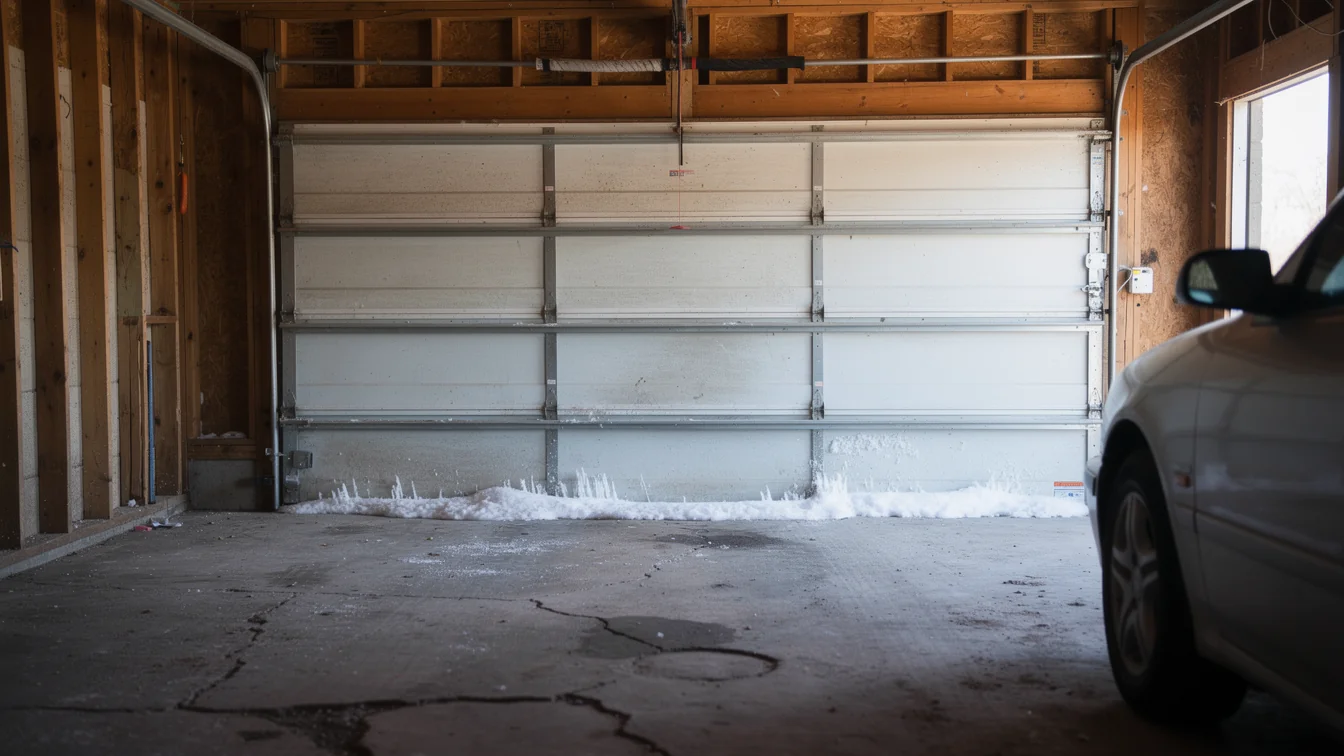
Cold does two things to an old door that a mild climate wouldn't. First, it stiffens the lubricant in rollers and hinges, which raises the load on a spring that's already decades past its rated cycle count - so the spring that was marginal in September snaps in a January cold snap. Second, it shrinks steel tracks slightly, which on a door that was never perfectly aligned to begin with (common in houses from the 1960s building boom) turns a minor rub into a binding point. Across a service area running from Rensselaer and Westmere four miles out to Watervliet and Hampton Manor, the housing is old enough and the winters are cold enough that this pattern repeats on nearly every street. A household income median of $86,398 in this area means most owners can afford a real repair when the time comes - the issue isn't cost, it's catching the hardware before it fails on the coldest night of the year instead of a Tuesday afternoon.
Frequently asked questions
My garage door is original to my 1960s house - is that a problem by itself?
Not by itself. Plenty of original hardware from that era still runs fine. The issue is that it's now 50-60 years into a system not designed to last that long, in a climate that's hard on steel. Age plus cold is what turns a working door into a sudden failure, usually in winter.
Why does my spring always seem to break in cold weather?
Cold stiffens the lubricant and makes steel slightly less flexible, so a spring that's already fatigued from decades of cycling is more likely to snap under load. It's not coincidence - it's the climate finding the weak link in hardware that's often original to a 1960s or 70s build.
Should I replace the whole door or just fix the spring?
Depends on the door. If the panels and track are sound and it's just the spring or a cable, repair makes sense. If the door is original to a house built before the 1970s and multiple parts are worn, replacing the whole unit is often cheaper over time than repeated repairs on obsolete hardware.
Related garage door services in Albany
More garage door guides
Book garage door service in Albany
Call now or request a quote - tell us what the door is doing and where you are.